
Just Behave and Be Good

How often have you told your child or student to “behave”? How about “be good”? Have you ever asked them, “Why can’t you just behave?” I know I have.

It is such an easy question to ask and the simple command of “behave” is even easier. After all, that covers all of our bases right? I mean it, I said, “behave” you know, “be good.”

Again, I find myself so much better at avoiding this as a teacher than as a parent. I know all my parent readers are tired of hearing me say that. Sorry, it’s true. I am constantly working on my carry over from the teacher to the mother role, but it is definitely still a noted weakness.

So, some of you may be thinking, “what’s wrong with telling our children to behave?” Let’s do a little exercise. Without over thinking it, tell yourself what it means to behave; say it out loud if that is easier. Now, ask the closest adult you to also define what it means to behave. Now, ask one more adult. Do your answers match? I am sure they are similar and run along the lines of following directions, complying with adults, doing what we know is right…Sound about right? Now, I want you to find your child. Ask them what it means to behave. See what they say. Close? Was their answer similar? Did it seem hard for them to answer? Did their answer seem scripted?

I think in most cases, the answers would be yes. Children need specific information when we are trying to form behavior. They do not need grey area. Keep it direct, simple, and black and white.

Behave= Lottie today when you go to school, I want you to focus on listening to your teacher and when she asks you a question, I want you to look at her eyes before you answer.

Behave= Lottie today I want you to use ‘sir’ and ‘maam’ each time you talk to an adult.

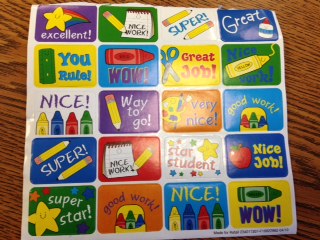
This rule also applies to reinforcing good behavior to our children. Compliments need to go farther than just “good job”. When I go to the School Box store and I see all of the stickers, I always dream of inventing one that leaves room to specify exactly what was “Well Done” or what “A+” means.

In short, we must be specific when we talk to our children. We need to give them well described directions. On the other side, we need to specifically reinforce their good efforts, even the small ones.

Good Job= Lottie I love how you stopped running when you saw your little sister today because you know you could have run into her and hurt her. Thank you.

Well Done= Lottie it is so great that you put your plate in the sink without me asking you do. That is a really good decision.

Using more detail in directions and compliments seems easy enough, but something else that we forget it to specifically praise children when they comply a little bit. I know how hard this is when dealing with extreme behaviors. As adults, we are so frustrated and obsessed with what they are doing wrong, we forget to dig and see what they are doing right. For example, when I have a student melting down, they may be telling me to “F-off”, and they may be throwing desks and supplies all around the room. Do they have my blood boiling? You bet they do. It takes all I have to positively reinforce the little things at this point, but this is the point where they need it the most.

Rewarding the Little Things= Timmy is in a full meltdown, cussing and turning the entire room over. Timmy picks up a chair over his head and acts as though he may throw it. Instead of throwing it, he puts it down (loudly of course). “Timmy, thank you so much for putting down the chair. That was a great decision. I am proud of you.”
image

Save Your Vocal Cords


Dear Yelling,

I know you far too well. I despise you. You are a direct sign of my impatience and you teach my children nothing. You scare my children.

Love,
Meredith as a Mom

Dear Yelling,

Who are you? I think I have used you twice in seven years and both times you pulled me farther and farther away from my goal of changing behavior in students. You don’t work. You do nothing for me, so I am glad I do not know you well.

Love,
Meredith as a Teacher

It is so interesting and frustrating to me how I use yelling in my day to day life. I NEVER yell at my students. First off, it does no good. If anything, I temporarily scare my students into behaving. I am not teaching them how to behave rather I am setting a terrible example for them. Thus, I don’t use yelling as a strategy with my students.

Often times, the children I work with are very black and white. The whole “grey area” concept is non-existent in their eyes. Therefore, I teach them by being their example. I role play with them as a way for them to see and feel what appropriate is. So if they see me yell, why would they not mimic me in their heated situations? The students don’t understand why I am allowed to yell, and they are not. For this, and many other reasons, I do not yell at my students.

Now I need to teach myself to practice what I preach and not yell at my own children. I am aware that yelling at them does nothing for them or me. I am not teaching them how to behave or how to be a well-rounded child; rather I am painting them a picture of a stressed-out and impatient mother. I have learned that it is a release for me when I am completely maxed out, and I used it as a personal intervention. Bad, bad, bad mommy.

As both a teacher and a parent, I aim to avoid a power struggle at all costs. Children with behavior disorders thrive on that struggle. They will do anything possible to “win”. I am ok with them winning. In fact, I often tell them they have won. This may seem weird, but once they have won, they have won. There is nothing else to fight for.This is the point when we can begin teaching and be done with the battle.

My new goal after honestly writing this entry is to not yell at my children. I know I will fumble, but I am going to make a conscious effort to eliminate this unnecessary and unproductive form of discipline. If anyone out there has replacement behavior options for me, please do share. I need to learn how to transfer my patience as a teacher into my parenting.

They Don’t Care What You Had for Dinner

Building relationships with children is the easiest way to change behavior. Of course, this task is much easier said than done. The root of the word “relationship” is “relate”. This is where things get sticky. It is impossible to relate to a child with behavioral disorders by asking them their favorite food or color or movie. It is much more than knowing that they like soccer, had pizza for dinner and don’t like their little sister. It’s about truly getting to know them as a child. One must put their behavior and words behind them and focus on the whole child.

Building a relationship and relating with children who are so different than you is not easy. As adults, we enjoy cooking, reading magazines and silence. Kids much prefer a Happy Meal to a Filet Mignon. They think magazines are solely for creating collages in Language Arts class, and they are uncomfortable with silence.

So, how do we relate to these kids? The answer is ever changing. Trust me; I am not expert at this, nor am I even close. I know that middle school boys don’t care about my last tennis match or the fact that Blake and I made homemade sushi. They don’t care about my youngest daughter saying “cheese” for the camera for the first time or that my oldest still cries daily when I drop her off to school.

In order to relate to kids, we have to find out what makes them tick. If it is video games, then learn about the ones they like. Bring in magazines or look on the internet with them and engage in this interest. Look into their eyes, and ask them questions. Learn more than just the name of the game. Ask about the characters, the goal, and the strategy they use when they play it. This allows the student to be the teacher, and it also allows them to see that we (as teachers, parents and adults) do not know everything and we NEED them to teach us. Allowing them to be a leader increases their confidence and takes away their need for a future power struggle. It also gives us the ammo we need to distract them when they begin to meltdown.

Right now, the child I am pouring my heart and soul into is an 8th grade boy who was a gypsy on the streets of a third world country for the first 10 years of his life. By gypsy, I mean he truly wandered without parents or any consistent adult or leader. After this, he was put into an orphanage for 2 years before he was adopted by his American parents. (Side note, how awesome are they for taking on this amazing task and saving this boy’s life?)
Each morning, this young man comes into my room. We are divided by the imaginary wall of language as he speaks very little English. When I speak, he reminds me that he doesn’t know what I am saying. Rather than giving up, I use visuals to communicate. I smile at him. I look into his eyes and tell him I am proud of him, while non-verbally opening my eyes wide with affirmation and giving him a thumbs up so he knows that I am pleased with his presence. I will create a bond with this child before he walks out of my school, this I promise you.

I have been working with him for one month now and his behavior has improved greatly. He was struggling with showing respect for authority figures and following classroom rules. Sure, he works on a behavior contract with me which helps, but I truly feel like the main behavior changer for him is to know he can come to me in the afternoon, and I will do all I can to tell him how proud I am of him. I truly love this child and he knows this.

I am finding a way to relate to him without the use of English language. I know what he likes, and I know what he doesn’t like. He knows that he can come to me when the world around him seems surreal. Can you imagine wandering the unpaved streets of your country day in and day out searching for food and fighting your way through life, and then ending up in a very affluent suburban town outside of Atlanta? Imagine having never stepped foot into a school and then walking into a school with flat screen photo displays on the walls, iPads in classrooms, and necklace microphones on teachers for a more clear delivery of the Dichotomous Key, Algebra, or Southeastern Asian Economics lessons. I would imagine that following directions and respecting said microphone accessory-wearing teachers would be a lot to ask.

After talking to his “dad” the other day, I learned that my little gypsy enjoys talking to me more than his outside therapist. When I asked his dad why he said this, his dad told me that my little gypsy thinks I am “real”. BINGO! My heart melted.

So, relate with these kids. Learn who they are. Learn what motivates them. Let them be leaders. Look them in the eyes. Touch them. Let them feel your love. They thrive on love and consistency. Their behavior has become their crutch to obtain your attention, and they can’t differentiate the positive and negative form of attention. Feed them with positive attention and get to know these kids. They are normal children who have been jaded by their impulsivity that they can’t control without you to teach them. Can you RELATE?

Do You Speak Behavior?

Hand’s down one of the most underappreciated and taken for granted skills in life is the ability to effectively communicate with one another. As I put my daughter to bed, I think about the students that I work with that lack the basic skills that she has acquired in the first three years of life.

“Lottie, go put on your pajamas and come read a book with me before bed.”

Lottie looks at me and says, “I am tired mommy, can I go to bed now?”

Simple right? She was tired and she told me. Simple for her, and perhaps you, but trust me, this type of communication and awareness has proven to be an major underlying behavior antecedent. For some children with Emotional and Behavior Disorders the simple identification of their feelings is impossible. They may feel something is wrong, something doesn’t feel quite right inside, but they do not know that that feeling is. Anger or fear or confusion or tiredness?  To them, it is an uneasy feeling inside. To communicate this unknown beast inside, they act out.

With the growing population of children using cell phones to non-verbally communicate, there is a direct decrease with the number of students being able to accurately express their emotions. Having verbal dialogue is in a sense a mirroring activity for them to see, identify and express emotions. “LOL” does mean that the person is laughing, but to not be able to see and hear that emotion will eventually create emotionless children. Don’t get me wrong, I embrace technology and know that it is imperative for the advancement of the human population, but we have to continue to encourage our children to verbally communicate and mirror and label appropriate emotions.

Now it is our goal to help these children identify that feeling and intervene in a way that will comfort them and allow them to express that feeling. When they are sad, they may never cry, but we can teach them to find a safe place and reflect.

Children with emotional behavioral disorders tend to fall into a compartment or a combination of compartments, and for each of these kids, there are interventions and strategies to encourage them to be able to communicate their feelings and emotions in an appropriate manner. It doesn’t matter if they are The Bully, The Passive Aggressor, The Ticking Time Bomb, The Obsessor, The Madman, The Arguer, The Angry Artist, The Nervous Nelly, The Survivor, The Socially Unaware, The Perseverator, The Teacher, or The Kid I Have Yet to Meet; there is a way for them to communicate without exhibiting inappropriate behavior.  After all, you can only shake a champagne bottle for so long before it eventually explodes. Let’s teach our children how to successfully pop the cork and allow the liquid to flow.