
Fine, You Win!!!… Or Do You?

As I have mentioned in previous posts, I am learning A LOT in my new role as a Special Education Facilitator. For the past 4 years, I have been confined to my precious, little self-contained behavior world. I lived in a world where I work I dressed in an emotion-proof vests and learned to let things totally roll off my shoulder. I can’t tell you how many times I have been told “F@ck You” in response to my everyday “Good Morning”.

Picture this, there I sit on the first preplanning week in my job as an EBD teacher. My walls are covered in inspirational posters and quotes about success strown throughout the room. The bulletin board is decorated perfectly with personal photos of each of my angels and a colorful paisley fabric in the background. Each student is provided with a pass pocket in their cubby as well as a personalized behavior contract and point check book. My standard based lesson plans are neatly placed on my desk underneath a Red Delicious apple, and I am ready to get this show on the road.

And then…the students arrive.

I won’t bore you with the details, but let’s just say I didn’t get to eat the apple. The inspirational quotes and posters became the root of jokes and were altered with Sharpee mustaches and inappropriate speech bubbles. The fabric which was once the background of the bulletin board was ripped off and recycled into a super hero cape. The behavior contracts were transformed into paper airplanes and thrown off the ledge and into the atrium where my principal was having a conversation with another teacher and the lesson plans were procrastinated to the following dayweek…year.

Needless to say, I had no idea what I was getting into and ultimately how much I loved my job.

I think that the skill of avoiding a power struggle was one of the hardest skills I had to learn. Think about it, you tell a kid good morning and they look at you with their 12-year-old eyes and tell you to F@@@ off! Nature would tell me to grab his arm and angrily escort him to the principal’s office to hear his unreasonable consequences. He is out of my room for the rest of the day, and he won’t be back to school until his 5 day out of school suspension is served. Boom! I win!

But, the question is, who is really the winner here? Sure, I proved my point to the classmates that I will not be disrespected, but in turn I gave the student the attention he desired as well as a 5 day vacation from school and all of the assignments he wanted to avoid anyway. I am going to say He Won.

I know what you are thinking. We have to demand respect or our society will crumble, and I agree with this. With that being said, avoiding the power struggle is the first step in doing this. When I marched my student down to the principal’s office, I minimized my authority and passed off a teachable moment just to prove a point.

I am not saying to allow students to cuss us out or be disrespectful to us, but I am saying that we should consider our responses to these actions and determine what is the right path to take to truly be the winner. After years in this setting, I have learned that when a student cusses at me, it is not personal. They just need to be taught an appropriate way to communicate.

Now when little Timmy walked into my room and tells me to F@*& off, I take one of three paths.

1. Verbally note that I heard him and in a calm voice ask him to meet me in the break room when he is ready to discuss a better way to communicate with me as well as what in the world went wrong before he walked into my room. This allows him to decompress a bit, think about his actions and communicate with me when he is ready. The calm response shows him that I am listening. The behavior (cussing) will be addressed when he is available to listen and learn from me. It is critical that you are 100% an active listener during this conversation. Focus, listen, ask questions, teach.

2. Completely ignore him and pay full attention to the students who are exhibiting appropriate behavior. When he acts out again in need of attention, I will take the path mentioned above.

3. This response is to be used a more extreme case and definitely has to be done in the right environment. Instantly after Timmy cusses at me, I will calmly take him to a private room with a timer. I will tell him that he is hand’s down the “Best Cusser I’ve Ever Met”. Then I will get the timer and act very excited and then tell him to say as many cuss words as he can in 1 minute. Emphasize how good he is at it, the best in fact. Ready, set, go! As he begins to cuss, catch him on repeats “opps you already said that one”, “come on…you know more than this- go go go! Your time is ticking.” I can almost guarantee that he will be done with words in 10-20 seconds. I know what you are thinking? What does this prove? It proves nothing other than that you aren’t going to let him get you worked up over a few cuss words. It removes the novelty and reaction from the behavior thus making it less exciting for the student. Every time I have done this, the behavior has decreased.

I can’t emphasize how much our reactions to our students and children dictate their behaviors. Think about it like this: A boxer punches his opponent in the head, jugular and side because he gets an immediate response. He knows this is where it hurts thus knocking his opponent’s guard down and allowing him to WIN. Our students, opponents if you will, want to get us where it hurts so that we will react. If we can limit and tone down our reactions, we will WIN.
Homework is Perfect for the Perfectly Average

This year I took on a new job where I see a totally different perspective of special education. It’s not a bad side or a good side, just a different side. The change has been quite trying, and there are days that I truly don’t want to go to work. Good Grief I have become more honest in my older age. Don’t get me wrong, I have amazing days as well.

That being said, one of the biggest highlights in my new job is the intellectual conversations I get to have with my coworkers. The other day, we were collaborating, and one of them said something that I have been reflecting upon ever since. She said that homework is nonsense. As a group we discussed how cool it would be to have a school or even a school district who piloted a No Homework policy for just one year.

Something I learned right out of the gate in this new position is to hold my tongue until I have given my brain adequate time to reflect, see all sides, internally dialogue and filter my thoughts. There is very little casual conversation in this role and oftentimes, my casual brainstorming can be used a factual guidance. Of course, my casual thoughts are tweaked a bit to be more fitting to the listened ultimate goal. OK that was a random tangent back to the topic. The whole point was I stayed quiet on this statement/idea until I had time to reflect on it and think about where I truly stood on the subject.

After that conversation took place, I reflected on what a school with no homework would look like. Would their scores tank? Would kids fall behind? Would they have time to learn everything they are expected to learn? Would our kids be prepared for college?

In the special education world, we are dealing with overwhelming and rapidly increasing levels of anxiety, OCD, behavior disorders, defiance, refusal, stress-based gastrointestinal issues, etc. When I think of the root of most of these problems, it starts at home. Trust me, this has nothing to do with parenting. Heck, I am a mother of a 5-year-old with unnatural anxiety and fear of separation, so no it’s not parents. The root of most of these anxiety-based issues is the incredible demands that we as a nation are putting on our children.

When I think back to my childhood, I had homework, but I don’t remember a time where I thought I was overwhelmed with it or couldn’t find time to play because I had 3 hours of work to do. The demands on children which ultimately lie on the back of parents and guardians are simply too high. There are a handful of kids who love homework and do it without a fight from their parents. It is natural and something that they intrinsically choose to do. With or without a homework policy, these students will still use their leisure time to learn more, study more and continue to strengthen their personal knowledge.

I would love to see a school adopt a No Homework Policy for one year while heavily encouraging the use of this valuable time to be time for dinner as a family, cooking together, going for walks, playing outside, watching a movie together or any other stress-reliving activity. This would promote both positive parents/children relationships and good health. My guess is that test scores would still remain the same, but the well-being of the children will be much more stable.

I am not sure what homework looks like at your house, but in all of the meetings I have sat it, it has been a major source of anxiety and disconnect in both students and parents. Just the simple step of lugging home 5 binders full of notes and then filtering through what the homework expectation is is enough to start the family time off to a stress-filled start. “Welcome home, get to work.” After 8 hours of learning, rule following and structure, parents and students both need time to simply decompress. I guarantee that the 3 extra hours of route learning, parent-enforced, drill and rep assignments are not moving us as a country to the highest level of academia, rather it is increasing depression, anxiety and disconnect with our students and children. How nice would it be to come home and know that family time will be exactly that- quality time spent together.

I know this will be a controversial blog entry, and I am prepared for that, but understand, it is simply my opinion and it’s worth exactly what you paid for it. 🙂

Just Behave and Be Good

How often have you told your child or student to “behave”? How about “be good”? Have you ever asked them, “Why can’t you just behave?” I know I have.

It is such an easy question to ask and the simple command of “behave” is even easier. After all, that covers all of our bases right? I mean it, I said, “behave” you know, “be good.”

Again, I find myself so much better at avoiding this as a teacher than as a parent. I know all my parent readers are tired of hearing me say that. Sorry, it’s true. I am constantly working on my carry over from the teacher to the mother role, but it is definitely still a noted weakness.

So, some of you may be thinking, “what’s wrong with telling our children to behave?” Let’s do a little exercise. Without over thinking it, tell yourself what it means to behave; say it out loud if that is easier. Now, ask the closest adult you to also define what it means to behave. Now, ask one more adult. Do your answers match? I am sure they are similar and run along the lines of following directions, complying with adults, doing what we know is right…Sound about right? Now, I want you to find your child. Ask them what it means to behave. See what they say. Close? Was their answer similar? Did it seem hard for them to answer? Did their answer seem scripted?

I think in most cases, the answers would be yes. Children need specific information when we are trying to form behavior. They do not need grey area. Keep it direct, simple, and black and white.

Behave= Lottie today when you go to school, I want you to focus on listening to your teacher and when she asks you a question, I want you to look at her eyes before you answer.

Behave= Lottie today I want you to use ‘sir’ and ‘maam’ each time you talk to an adult.

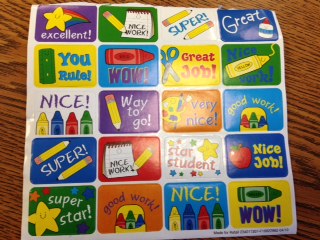
This rule also applies to reinforcing good behavior to our children. Compliments need to go farther than just “good job”. When I go to the School Box store and I see all of the stickers, I always dream of inventing one that leaves room to specify exactly what was “Well Done” or what “A+” means.

In short, we must be specific when we talk to our children. We need to give them well described directions. On the other side, we need to specifically reinforce their good efforts, even the small ones.

Good Job= Lottie I love how you stopped running when you saw your little sister today because you know you could have run into her and hurt her. Thank you.

Well Done= Lottie it is so great that you put your plate in the sink without me asking you do. That is a really good decision.

Using more detail in directions and compliments seems easy enough, but something else that we forget it to specifically praise children when they comply a little bit. I know how hard this is when dealing with extreme behaviors. As adults, we are so frustrated and obsessed with what they are doing wrong, we forget to dig and see what they are doing right. For example, when I have a student melting down, they may be telling me to “F-off”, and they may be throwing desks and supplies all around the room. Do they have my blood boiling? You bet they do. It takes all I have to positively reinforce the little things at this point, but this is the point where they need it the most.

Rewarding the Little Things= Timmy is in a full meltdown, cussing and turning the entire room over. Timmy picks up a chair over his head and acts as though he may throw it. Instead of throwing it, he puts it down (loudly of course). “Timmy, thank you so much for putting down the chair. That was a great decision. I am proud of you.”

image