
How often have you told your child or student to “behave”? How about “be good”? Have you ever asked them, “Why can’t you just behave?” I know I have.
It is such an easy question to ask and the simple command of “behave” is even easier. After all, that covers all of our bases right? I mean it, I said, “behave” you know, “be good.”
Again, I find myself so much better at avoiding this as a teacher than as a parent. I know all my parent readers are tired of hearing me say that. Sorry, it’s true. I am constantly working on my carry over from the teacher to the mother role, but it is definitely still a noted weakness.
So, some of you may be thinking, “what’s wrong with telling our children to behave?” Let’s do a little exercise. Without over thinking it, tell yourself what it means to behave; say it out loud if that is easier. Now, ask the closest adult you to also define what it means to behave. Now, ask one more adult. Do your answers match? I am sure they are similar and run along the lines of following directions, complying with adults, doing what we know is right…Sound about right? Now, I want you to find your child. Ask them what it means to behave. See what they say. Close? Was their answer similar? Did it seem hard for them to answer? Did their answer seem scripted?
I think in most cases, the answers would be yes. Children need specific information when we are trying to form behavior. They do not need grey area. Keep it direct, simple, and black and white.
Behave= Lottie today when you go to school, I want you to focus on listening to your teacher and when she asks you a question, I want you to look at her eyes before you answer.
Behave= Lottie today I want you to use ‘sir’ and ‘maam’ each time you talk to an adult.
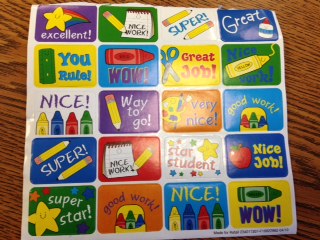
This rule also applies to reinforcing good behavior to our children. Compliments need to go farther than just “good job”. When I go to the School Box store and I see all of the stickers, I always dream of inventing one that leaves room to specify exactly what was “Well Done” or what “A+” means.
In short, we must be specific when we talk to our children. We need to give them well described directions. On the other side, we need to specifically reinforce their good efforts, even the small ones.
Good Job= Lottie I love how you stopped running when you saw your little sister today because you know you could have run into her and hurt her. Thank you.
Well Done= Lottie it is so great that you put your plate in the sink without me asking you do. That is a really good decision.
Using more detail in directions and compliments seems easy enough, but something else that we forget it to specifically praise children when they comply a little bit. I know how hard this is when dealing with extreme behaviors. As adults, we are so frustrated and obsessed with what they are doing wrong, we forget to dig and see what they are doing right. For example, when I have a student melting down, they may be telling me to “F-off”, and they may be throwing desks and supplies all around the room. Do they have my blood boiling? You bet they do. It takes all I have to positively reinforce the little things at this point, but this is the point where they need it the most.
Rewarding the Little Things= Timmy is in a full meltdown, cussing and turning the entire room over. Timmy picks up a chair over his head and acts as though he may throw it. Instead of throwing it, he puts it down (loudly of course). “Timmy, thank you so much for putting down the chair. That was a great decision. I am proud of you.”
 Behave Louder, I Can't Hear You