
Summer time has started. I always find it interesting how kids look so forward to summer, and then when it hits, the boredom sinks in within a week. For parents, summer comes with sunshine and happiness and a small dose of juggling new childcare, trying to fill unstructured endless days, bags and baskets of pool gear which typically go unused once actually getting to the kid pool, carloads of smashing and packing to get the family to the beach, goldfish crumbs and watermelon juice on the floorboards and constant Sunscreen Hand. Maybe I am blanket stating, but this is what my summer seems like. Getting past all the hustle and bustle of the relaxing summer is ok, but there is something about summer that makes my personal children behave like they have eaten 10 packs of Skittles for 14 consecutive hours. During the school year, the routine keeps us focused and structured, but once the last bus stop unloads, it’s on baby!
Yesterday, I met a great friend for lunch at Mr. Sushi. Don’t even get me started on that name. The sushi is top-notch, but the name lacks so much creativity. Can you imagine how boring our world would be if we used this same concept for all of our public establishments? Mr. School, Mrs. Sub Sandwich, Miss. Grocery Store, Mr. Karate Studio, Ms. Movie Theater- ooppps~~ Classic Foster Tangent
Anyway, back to the meat of the conversation. My friend and I got to talking about teenage behavior, sibling competition, and emotional regulation. For some you may be thinking, what a lame lunch topic, but the behavior nerd in me couldn’t get enough. As I listened to my dear friend asking heartfelt and meaningful questions about intervening on his son’s behavior before it was too late, so many things crossed my mind about the complexity of innate reactions and adolescent impulsivity.
Now, I can tell you all the “you-shoulds” and “you-should-nots” you want to hear, but I want to make it clear that letting go of the “why” is not something I have mastered in my own parenting, teaching or being a wife. Now that I have put that out there, let’s move on to a few ways help identify the “why” without asking “why?”.
Let’s set the stage here:
The other night my daughter Lottie was literally out of her mind. I am talking lying on the floor screaming, crying, punching, kicking everything in sight because I took away her Bubble Tape (I am seriously telling the truth here both on the antecedent and the response). I let her attempt to work it out for 10 minutes before my emotional regulation went out the window, I stormed in and yelled “WHY in the world are you acting this way???” This is my own double pet peeve, and I caught myself letting go of my own personal strategies, letting my emotional regulation hit a 5 (this will make more sense by the end of this post) and yelling at my daughter when she was in an incredibly emotional state desperately begging for love, nurture and acceptance. Why did I do this? Because I am human, and even though I was able to spend countless days in my classroom with students in this same or worse emotional state without yelling or asking why, when it was my own personal child, my weakness was exposed, and I lost control.
A few questions to ponder in reflection to this scenario…
- Do you think this Lottie knew WHY she was acting that way?
- Did I know WHY I was acting that way?
- Do you think my yelling and questioning helped her curb the behavior?
- Do you think that this was a good teachable moment for her?
- No
- No
- No
- No
As humans, we are inquisitive. We desperately want to know why a child chose to punch his classmate rather than telling the teacher the class mate was being mean. We want to know why our husbands and wives can’t love us in the same ways that we love them. We want to know why our kids won’t study and why they don’t care about school. We are never-ending why wonders, but at the end of the day, does why really matter? No, it really doesn’t. What matters is that we teach our children HOW to make better decisions and for adolescence and teens (and even adults) this is something that requires true strategies to break the nature human innate impulsive response.
Step one in this process is to teach our children to be able to identify HOW they feel. Through my observation, I have found the most success with teaching children to emotionally regulate by attaching their feeling to a physical understanding. For example, rather than me telling my 12-year-old, pubescent, impulsive, ornery student that he appears to be getting angry, I gave him something that he can see or feel. “Hey Tommy, I notice that you are pacing and you’re starting to clench your fist. Can we go for a quick walk outside and toss the football?” With this tactic, Tommy can actually feel that he is getting angry without me pointing out to him that he is angry. Once he can identify, he can use an individual strategy to prevent or get back to an appropriate state.
Here is the Emotional Reg Tool I created from the structure of Kari Dunn Buron’s Incredible 5 Point Scale
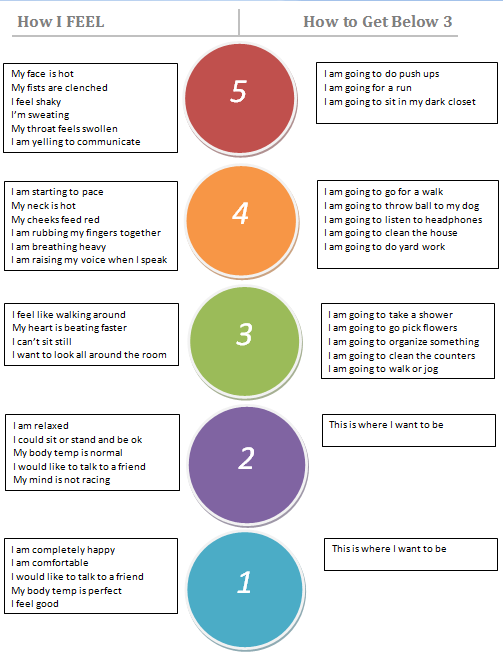
It is important that the child is involved in creating their own Emotional Regulation Tool so that they can own it. The one above is mine, so my physical responses will be different from my 6-year-old daughter’s or my 13-year-old student’s. As with all interventions, if there is no buy in from the child, there is no success. I personally use this tool as a grown adult. I will often yell “I am a 5 right now so I am going for a run! BYE! (insert slamming door here).” I always remind myself that I am human, so I will get to a 5, but it’s important that I don’t stay there long. This hold true with our children as well.
The final component to this would be to tie a tangible reward into the plan reinforcing both staying at a 3 or lower or if the child gets to a 4/5, they appropriately use a strategy to get back below 3. Both are to be rewarded after this is the replacement behavior we want.
This has been a successful strategy for most of my impulsive kids. It works, don’t ask me WHY.
*This emotional regulation tool was generated from the basic structure of The Incredible 5 Point Scale by Kari Dunn Buron http://www.5pointscale.com/ *
 Behave Louder, I Can't Hear You