
Letting Go of WHY

Summer time has started. I always find it interesting how kids look so forward to summer, and then when it hits, the boredom sinks in within a week. For parents, summer comes with sunshine and happiness and a small dose of juggling new childcare, trying to fill unstructured endless days, bags and baskets of pool gear which typically go unused once actually getting to the kid pool, carloads of smashing and packing to get the family to the beach, goldfish crumbs and watermelon juice on the floorboards and constant Sunscreen Hand. Maybe I am blanket stating, but this is what my summer seems like. Getting past all the hustle and bustle of the relaxing summer is ok, but there is something about summer that makes my personal children behave like they have eaten 10 packs of Skittles for 14 consecutive hours. During the school year, the routine keeps us focused and structured, but once the last bus stop unloads, it’s on baby!

Yesterday, I met a great friend for lunch at Mr. Sushi. Don’t even get me started on that name. The sushi is top-notch, but the name lacks so much creativity. Can you imagine how boring our world would be if we used this same concept for all of our public establishments?  Mr. School, Mrs. Sub Sandwich, Miss. Grocery Store, Mr. Karate Studio, Ms. Movie Theater- ooppps~~ Classic Foster Tangent

Anyway, back to the meat of the conversation. My friend and I got to talking about teenage behavior, sibling competition, and emotional regulation. For some you may be thinking, what a lame lunch topic, but the behavior nerd in me couldn’t get enough. As I listened to my dear friend asking heartfelt and meaningful questions about intervening on his son’s behavior before it was too late, so many things crossed my mind about the complexity of innate reactions and adolescent impulsivity.

Now, I can tell you all the “you-shoulds” and “you-should-nots” you want to hear, but I want to make it clear that letting go of the “why” is not something I have mastered in my own parenting, teaching or being a wife. Now that I have put that out there, let’s move on to a few ways help identify the “why” without asking “why?”.

Let’s set the stage here:

The other night my daughter Lottie was literally out of her mind. I am talking lying on the floor screaming, crying, punching, kicking everything in sight because I took away her Bubble Tape (I am seriously telling the truth here both on the antecedent and the response). I let her attempt to work it out for 10 minutes before my emotional regulation went out the window, I stormed in and yelled “WHY in the world are you acting this way???” This is my own double pet peeve, and I caught myself letting go of my own personal strategies, letting my emotional regulation hit a 5 (this will make more sense by the end of this post) and yelling at my daughter when she was in an incredibly emotional state desperately begging for love, nurture and acceptance. Why did I do this? Because I am human, and even though I was able to spend countless days in my classroom with students in this same or worse emotional state without yelling or asking why, when it was my own personal child, my weakness was exposed, and I lost control.

A few questions to ponder in reflection to this scenario…

  1. Do you think this Lottie knew WHY she was acting that way?
  2. Did I know WHY I was acting that way?
  3. Do you think my yelling and questioning helped her curb the behavior?
  4. Do you think that this was a good teachable moment for her?
  1. No
  2. No
  3. No
  4. No

As humans, we are inquisitive. We desperately want to know why a child chose to punch his classmate rather than telling the teacher the class mate was being mean. We want to know why our husbands and wives can’t love us in the same ways that we love them. We want to know why our kids won’t study and why they don’t care about school. We are never-ending why wonders, but at the end of the day, does why really matter? No, it really doesn’t. What matters is that we teach our children HOW to make better decisions and for adolescence and teens (and even adults) this is something that requires true strategies to break the nature human innate impulsive response.

Step one in this process is to teach our children to be able to identify HOW they feel. Through my observation, I have found the most success with teaching children to emotionally regulate by attaching their feeling to a physical understanding. For example, rather than me telling my 12-year-old, pubescent, impulsive, ornery student that he appears to be getting angry, I gave him something that he can see or feel. “Hey Tommy, I notice that you are pacing and you’re starting to clench your fist. Can we go for a quick walk outside and toss the football?” With this tactic, Tommy can actually feel that he is getting angry without me pointing out to him that he is angry. Once he can identify, he can use an individual strategy to prevent or get back to an appropriate state.

Here is the Emotional Reg Tool I created from the structure of Kari Dunn Buron’s Incredible 5 Point Scale
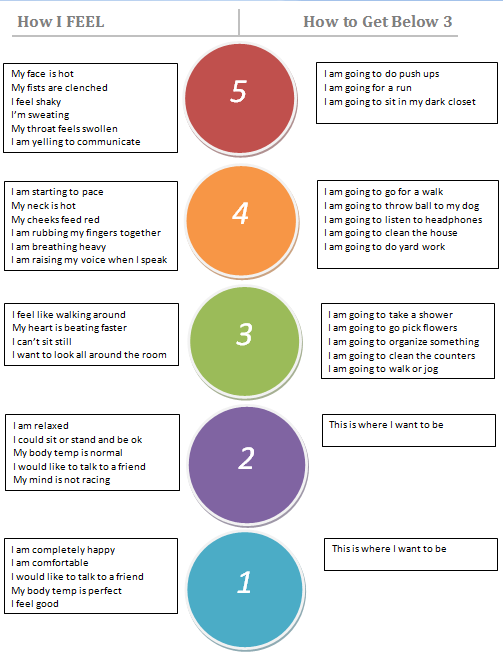
photo ER

It is important that the child is involved in creating their own Emotional Regulation Tool so that they can own it. The one above is mine, so my physical responses will be different from my 6-year-old daughter’s or my 13-year-old student’s. As with all interventions, if there is no buy in from the child, there is no success. I personally use this tool as a grown adult. I will often yell “I am a 5 right now so I am going for a run! BYE! (insert slamming door here).” I always remind myself that I am human, so I will get to a 5, but it’s important that I don’t stay there long. This hold true with our children as well.

The final component to this would be to tie a tangible reward into the plan reinforcing both staying at a 3 or lower or if the child gets to a 4/5, they appropriately use a strategy to get back below 3. Both are to be rewarded after this is the replacement behavior we want.

This has been a successful strategy for most of my impulsive kids. It works, don’t ask me WHY.

*This emotional regulation tool was generated from the basic structure of The Incredible 5 Point Scale by Kari Dunn Buron http://www.5pointscale.com/ *

Fine, You Win!!!… Or Do You?

As I have mentioned in previous posts, I am learning A LOT in my new role as a Special Education Facilitator. For the past 4 years, I have been confined to my precious, little self-contained behavior world. I lived in a world where I work I dressed in an emotion-proof vests and learned to let things totally roll off my shoulder. I can’t tell you how many times I have been told “F@ck You” in response to my everyday “Good Morning”.

Picture this, there I sit on the first preplanning week in my job as an EBD teacher. My walls are covered in inspirational posters and quotes about success strown throughout the room. The bulletin board is decorated perfectly with personal photos of each of my angels and a colorful paisley fabric in the background. Each student is provided with a pass pocket in their cubby as well as a personalized behavior contract and point check book. My standard based lesson plans are neatly placed on my desk underneath a Red Delicious apple, and I am ready to get this show on the road.

And then…the students arrive.

I won’t bore you with the details, but let’s just say I didn’t get to eat the apple. The inspirational quotes and posters became the root of jokes and were altered with Sharpee mustaches and inappropriate speech bubbles. The fabric which was once the background of the bulletin board was ripped off and recycled into a super hero cape. The behavior contracts were transformed into paper airplanes and thrown off the ledge and into the atrium where my principal was having a conversation with another teacher and the lesson plans were procrastinated to the following dayweek…year.

Needless to say, I had no idea what I was getting into and ultimately how much I loved my job.

I think that the skill of avoiding a power struggle was one of the hardest skills I had to learn. Think about it, you tell a kid good morning and they look at you with their 12-year-old eyes and tell you to F@@@ off! Nature would tell me to grab his arm and angrily escort him to the principal’s office to hear his unreasonable consequences. He is out of my room for the rest of the day, and he won’t be back to school until his 5 day out of school suspension is served. Boom! I win!

But, the question is, who is really the winner here? Sure, I proved my point to the classmates that I will not be disrespected, but in turn I gave the student the attention he desired as well as a 5 day vacation from school and all of the assignments he wanted to avoid anyway. I am going to say He Won.

I know what you are thinking. We have to demand respect or our society will crumble, and I agree with this. With that being said, avoiding the power struggle is the first step in doing this. When I marched my student down to the principal’s office, I minimized my authority and passed off a teachable moment just to prove a point.

I am not saying to allow students to cuss us out or be disrespectful to us, but I am saying that we should consider our responses to these actions and determine what is the right path to take to truly be the winner. After years in this setting, I have learned that when a student cusses at me, it is not personal. They just need to be taught an appropriate way to communicate.

Now when little Timmy walked into my room and tells me to F@*& off, I take one of three paths.

1. Verbally note that I heard him and in a calm voice ask him to meet me in the break room when he is ready to discuss a better way to communicate with me as well as what in the world went wrong before he walked into my room. This allows him to decompress a bit, think about his actions and communicate with me when he is ready. The calm response shows him that I am listening. The behavior (cussing) will be addressed when he is available to listen and learn from me. It is critical that you are 100% an active listener during this conversation. Focus, listen, ask questions, teach.

2. Completely ignore him and pay full attention to the students who are exhibiting appropriate behavior. When he acts out again in need of attention, I will take the path mentioned above.

3. This response is to be used a more extreme case and definitely has to be done in the right environment. Instantly after Timmy cusses at me, I will calmly take him to a private room with a timer. I will tell him that he is hand’s down the “Best Cusser I’ve Ever Met”. Then I will get the timer and act very excited and then tell him to say as many cuss words as he can in 1 minute. Emphasize how good he is at it, the best in fact. Ready, set, go! As he begins to cuss, catch him on repeats “opps you already said that one”, “come on…you know more than this- go go go! Your time is ticking.” I can almost guarantee that he will be done with words in 10-20 seconds. I know what you are thinking? What does this prove? It proves nothing other than that you aren’t going to let him get you worked up over a few cuss words. It removes the novelty and reaction from the behavior thus making it less exciting for the student. Every time I have done this, the behavior has decreased.

I can’t emphasize how much our reactions to our students and children dictate their behaviors. Think about it like this: A boxer punches his opponent in the head, jugular and side because he gets an immediate response. He knows this is where it hurts thus knocking his opponent’s guard down and allowing him to WIN. Our students, opponents if you will, want to get us where it hurts so that we will react. If we can limit and tone down our reactions, we will WIN.

Homework is Perfect for the Perfectly Average

This year I took on a new job where I see a totally different perspective of special education. It’s not a bad side or a good side, just a different side. The change has been quite trying, and there are days that I truly don’t want to go to work. Good Grief I have become more honest in my older age. Don’t get me wrong, I have amazing days as well.

That being said, one of the biggest highlights in my new job is the intellectual conversations I get to have with my coworkers. The other day, we were collaborating, and one of them said something that I have been reflecting upon ever since. She said that homework is nonsense. As a group we discussed how cool it would be to have a school or even a school district who piloted a No Homework policy for just one year.

Something I learned right out of the gate in this new position is to hold my tongue until I have given my brain adequate time to reflect, see all sides, internally dialogue and filter my thoughts. There is very little casual conversation in this role and oftentimes, my casual brainstorming can be used a factual guidance. Of course, my casual thoughts are tweaked a bit to be more fitting to the listened ultimate goal. OK that was a random tangent back to the topic. The whole point was I stayed quiet on this statement/idea until I had time to reflect on it and think about where I truly stood on the subject.

After that conversation took place, I reflected on what a school with no homework would look like. Would their scores tank? Would kids fall behind? Would they have time to learn everything they are expected to learn? Would our kids be prepared for college?

In the special education world, we are dealing with overwhelming and rapidly increasing levels of anxiety, OCD, behavior disorders, defiance, refusal, stress-based gastrointestinal issues, etc. When I think of the root of most of these problems, it starts at home. Trust me, this has nothing to do with parenting. Heck, I am a mother of a 5-year-old with unnatural anxiety and fear of separation, so no it’s not parents. The root of most of these anxiety-based issues is the incredible demands that we as a nation are putting on our children.

When I think back to my childhood, I had homework, but I don’t remember a time where I thought I was overwhelmed with it or couldn’t find time to play because I had 3 hours of work to do. The demands on children which ultimately lie on the back of parents and guardians are simply too high. There are a handful of kids who love homework and do it without a fight from their parents. It is natural and something that they intrinsically choose to do. With or without a homework policy, these students will still use their leisure time to learn more, study more and continue to strengthen their personal knowledge.

I would love to see a school adopt a No Homework Policy for one year while heavily encouraging the use of this valuable time to be time for dinner as a family, cooking together, going for walks, playing outside, watching a movie together or any other stress-reliving activity. This would promote both positive parents/children relationships and good health. My guess is that test scores would still remain the same, but the well-being of the children will be much more stable.

I am not sure what homework looks like at your house, but in all of the meetings I have sat it, it has been a major source of anxiety and disconnect in both students and parents. Just the simple step of lugging home 5 binders full of notes and then filtering through what the homework expectation is is enough to start the family time off to a stress-filled start. “Welcome home, get to work.” After 8 hours of learning, rule following and structure, parents and students both need time to simply decompress. I guarantee that the 3 extra hours of route learning, parent-enforced, drill and rep assignments are not moving us as a country to the highest level of academia, rather it is increasing depression, anxiety and disconnect with our students and children. How nice would it be to come home and know that family time will be exactly that- quality time spent together.

I know this will be a controversial blog entry, and I am prepared for that, but understand, it is simply my opinion and it’s worth exactly what you paid for it. 🙂

Save Your Vocal Cords


Dear Yelling,

I know you far too well. I despise you. You are a direct sign of my impatience and you teach my children nothing. You scare my children.

Love,
Meredith as a Mom

Dear Yelling,

Who are you? I think I have used you twice in seven years and both times you pulled me farther and farther away from my goal of changing behavior in students. You don’t work. You do nothing for me, so I am glad I do not know you well.

Love,
Meredith as a Teacher

It is so interesting and frustrating to me how I use yelling in my day to day life. I NEVER yell at my students. First off, it does no good. If anything, I temporarily scare my students into behaving. I am not teaching them how to behave rather I am setting a terrible example for them. Thus, I don’t use yelling as a strategy with my students.

Often times, the children I work with are very black and white. The whole “grey area” concept is non-existent in their eyes. Therefore, I teach them by being their example. I role play with them as a way for them to see and feel what appropriate is. So if they see me yell, why would they not mimic me in their heated situations? The students don’t understand why I am allowed to yell, and they are not. For this, and many other reasons, I do not yell at my students.

Now I need to teach myself to practice what I preach and not yell at my own children. I am aware that yelling at them does nothing for them or me. I am not teaching them how to behave or how to be a well-rounded child; rather I am painting them a picture of a stressed-out and impatient mother. I have learned that it is a release for me when I am completely maxed out, and I used it as a personal intervention. Bad, bad, bad mommy.

As both a teacher and a parent, I aim to avoid a power struggle at all costs. Children with behavior disorders thrive on that struggle. They will do anything possible to “win”. I am ok with them winning. In fact, I often tell them they have won. This may seem weird, but once they have won, they have won. There is nothing else to fight for.This is the point when we can begin teaching and be done with the battle.

My new goal after honestly writing this entry is to not yell at my children. I know I will fumble, but I am going to make a conscious effort to eliminate this unnecessary and unproductive form of discipline. If anyone out there has replacement behavior options for me, please do share. I need to learn how to transfer my patience as a teacher into my parenting.